R&D KOSÉ Wins Two Best Paper Prizes in Japanese Cosmetic Science Journals, The Journal of SCCJ and ACST 2026.06.05 Show Full [ PDF / 400KB ]
KOSÉ Corporation won the 2025 Best Paper Prize by the Society of Cosmetic Chemists of Japan (SCCJ) in both of its academic journals, the Journal of SCCJ and Applied Cosmetic Science and Technology (ACST) ※1,2. These award-winning studies uncovered that lip chapping includes a distinct type invisible to the eye, and identified three specific light reflectance patterns that universally enhance interpersonal impressions across diverse global skin tones.
※1 ACST is an English-language academic journal launched by the SCCJ in April 2025
※2 Award page on the Society of Cosmetic Chemists of Japan (SCCJ) website (Japanese)
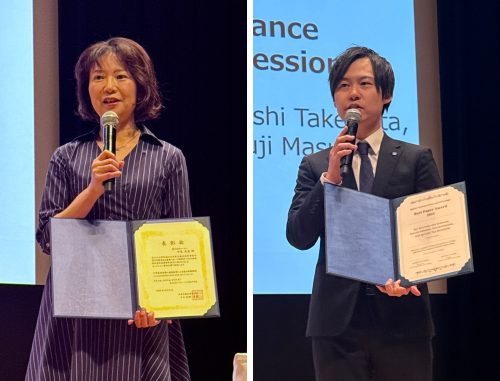
Emi Hokao (left), winner of the Journal of SCCJ best paper award,
and Ryo Kakimoto (right), winner of ACST best paper award
The Journal of SCCJ: 2025 Best Paper Prize Winning Research
・Paper Title: The Analysis of Chapped Lip Surface Properties by Successive Observations
・Authors: Emi Hokao, Mutsumi Yamanoi, and Fumihito Udagawa (KOSÉ Corporation)
Research Overview
The lips have a weak barrier function and are highly susceptible to dryness, with lip cream application being the standard care. However, consumer insights revealed a segment of users who experience persistent peeling or lack of improvement despite using lip creams. Hypothesizing that variations in underlying lip conditions dictate the perceived efficacy of skincare, the research team analyzed diverse lip attributes and sensory experiences.
Through close observation of lip surface conditions across 141 participants, the team discovered that alongside the conventional “Type A” (where peeling and scaling are visually apparent), there exists a distinct “Type B”—where individuals feel severe chapping and tightness despite no visible peeling (Figure 1).
Biophysical analysis revealed that while Type A features lower moisture levels and a hardened skin surface compared to healthy lips, Type B maintains similar moisture levels but exhibits significantly elevated transepidermal water loss (TEWL). Furthermore, a cross-cultural survey spanning Japan, China, and the United States confirmed that a consistent percentage of the population falls into Type B. This research highlights the necessity of developing tailored formulations targeting specific types of lip chapping.
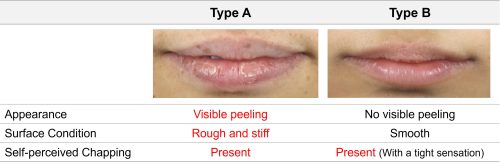
Figure 1. Characteristics of Lip Chapping Types
ACST: 2025 Best Paper Prize Winning Research
・Paper Title: Discovery of Global Common Denominators of Skin Reflectance that Enhance Attractive Impressions
・Authors: Ryo Kakimoto, Emi Kakizawa, Takeshi Taketa, Yuki Kotakeyama, Keiji Igarashi, and Yuji Masubuchi (KOSÉ Corporation)
Research Overview
To address evolving global needs celebrating diverse individualities, KOSÉ aimed to develop foundations that elevate an individual’s unique attractiveness rather than merely concealing skin imperfections. The team focused on “spectral reflectance,” the color patterns embedded in light reflected off the skin. First, utilizing a proprietary statistical method to analyze skin spectral reflectance data from various ethnicities—including Asian, Caucasian, and African American populations—the team categorized global skin tones into six distinct groups.
Next, using the “Multi-Wavelength Observation Room” capable of reproducing numerous combinations of spectral reflectance patterns, the team irradiated 44 participants of varying skin tones with diverse light patterns to evaluate the relationship between spectral reflectance and interpersonal impressions.
The investigation successfully identified three universal reflectance patterns that enhance positive impressions across all global skin tones (Figure 2):
1.“Violet or Blue” reflectance, which accentuates Elegant and Clear impressions.
2.“Orange or Red” reflectance, which evokes a sense of Warm impressions.
3.“Both Blue and Red” reflectance, which projects a Lively and Healthy impression.
Furthermore, foundations designed to accentuate each pattern were developed and evaluated, validating their efficacy in boosting targeted interpersonal impressions exactly as predicted. This milestone offers high versatility for application in future base makeup products tailored to help consumers achieve their desired look.
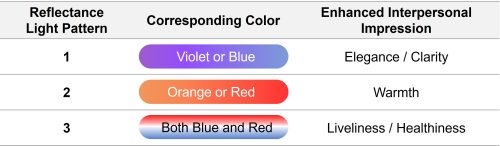
Figure 2. Three Light Reflectance Patterns That Universally Enhance Interpersonal Impressions
Future Outlook
These accolades reflect the high level of KOSÉ’s research and technology in makeup and skincare, serving as core foundational technologies for premium product development. KOSÉ remains committed to advancing scientific research and development to deliver enhanced functionality and innovative value to global consumers.
Share