Medium- to Long-term Targets
In conjunction with the non-financial goals of the medium- to long-term vision, we have set a commitment and targets for "For People" and "For the Earth" by 2030 as a medium-term milestone in our Sustainability Strategy in order to address material issues related to “people and society” and “global environment”
Sustainability Strategy: Material Issues and Medium-Term Targets
| Material Issues | Commitment | Indicators | Targets | Achieve by | Examples of Specific Measures | Relevant SDGs | |
|---|---|---|---|---|---|---|---|
| For People | Respect the diverse array of beauty | Through adaptability, provide products and services where customers of various backgrounds can experience their own unique beauty | Ratio of products and services provided based on Adaptability ∞(Eight) | 100%*1 | 2030 |
|
|
| Support the healthy minds and healthy lives | Pursue activities where the people of society can experience well-being through beauty | No. of initiatives for achieving well-being | 500 or more activities | 2030 |
|
|
|
| No. of participants in social contribution activities based on hands-on experiences | 50,000 or more | 2030 |
|
||||
| Procurement rate of certified raw materials and purchase of RSPO-certified credits through the Book & Claim (B&C) supply chain model | 100% | 2030 |
|
|
|||
| Help with social opportunities | Raise awareness and provide opportunities to participate in society for people of all diversities | No.of people reached through DE&I awareness initiatives focusing on the 3Gs*2 | 1 million or more people | 2030 |
|
|
|
*1: Each brand selects focus areas annually from KOSE’s eight unique Adaptability ∞ (eight) themes. The overall achievement rate is calculated based on the number of services/products delivered for those selected items.
*2: Global, Gender, and Generation
| Material Issues | Commitment | Indicators | Targets | Achieve by | Examples of Specific Measures | Relevant SDGs | |
|---|---|---|---|---|---|---|---|
| For the Earth | Increase awareness of environmental issues | Provide customers with opportunities to become aware of environmental issues through products, services, and information communicated | No. of people reached through environmental awareness initiatives through products, services and information sharing | 10 million people or more | 2030 |
|
|
| No. of people reached through water conservation awareness initiatives | 2 million or more | 2030 |
|
||||
| Play a role in solving environmental issues | Pursue conservation and solving issues in various regions around the world | No. of activities contributing to the global environment | 100 activities or more | 2030 |
|
||
| No. of participants in environmental conservation activities for waterfront areas | 10,000 or more | 2030 |
|
||||
| No. of initiatives that contribute to the conservation and restoration of ecosystems in raw material cultivation areas | 30 activities or more | 2030 |
|
||||
| No. of water source conservation initiatives | 10 initiatives or more | 2030 |
|
||||
| Area planted with coral reefs | 20,000㎡ About 53 times the area of a 25m Regulation size swimming pool | 2030 |
*Target is total area since 2009 |
||||
| Promote reduction of environmental impact | Reduce CO2 emissions | Scope 1・2 | -55%
(Target for total emission reduction vs. 2018) |
2030 |
*Green-house gas possibly emitted by the KOSÉ Group only identified as CO2 |
|
|
| Carbon Neutrality | 2040 | ||||||
| Scope 3 | -30%
(Target for total emission reduction vs. 2018) |
2030 | |||||
| Scope1・2・3 | Net Zero | 2050 | |||||
| Sustainability-conscious design for plastic packaging materials | Usage rate of containers and packaging materials aligned with the 4Rs | 100%*1 | 2030 |
* Reduce, Reuse, Recycle, Renewable |
|
||
| Usage rate of recycled and biomass plastic | 50%*1 | ||||||
| Reduction rate in the use of petroleumbased virgin plastic | -50%*2
Per-unit production vs. 2018 |
||||||
| Refillable container share | 50%*3 | ||||||
| Waste reduction for the purpose of responsible resource utilization | Waste that is not sent to landfills | Scheduled for disclosure in 2027 | 2030 |
*Reduce, Reuse, Recycle |
|
||
| Reduce use of water resources through responsible practices | Water usage reduction rate | -12%*4
Per-unit production vs. 2018 |
2030 |
|
|
||
| Responsible palm oil procurement | Procurement rate of certified raw materials and purchase of RSPO-certified credits through the Book & Claim (B&C) supply chain model | 100% | 2030 |
|
|
||
*1: Figures for new products launched within the target achievement year
*2: Products shipped in the subject year
*3: Applies to bottle and jar containers for skincare and haircare products included in the lineup for the relevant year
*4: KOSÉ Group manufacturing departments
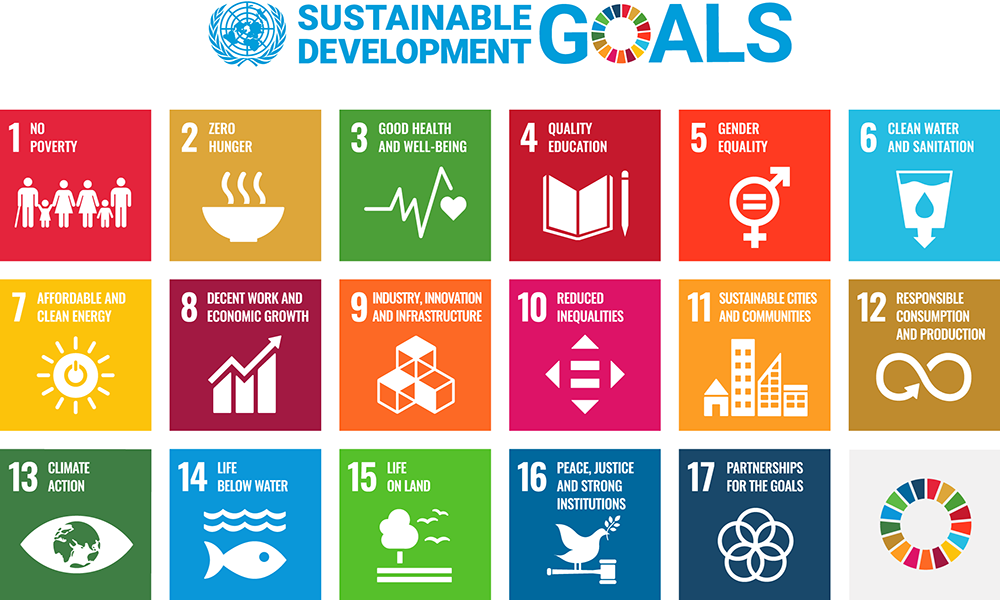
About Sustainable Development Goals (SDGs)Quoted from
the Global Compact Network Japan website
In September 2015, member states (193 states) of the United Nations adopted a set of goals to end
poverty, protect the planet, and ensure prosperity for all as part of a new sustainable
development agenda in the next 15 years. This agenda is called Sustainable Development Goals
(SDGs).
SDGs is an expansive challenge by the entire world to engage to ensure that no one is left
behind. It includes issues that were not fully addressed in the Millennium Development Goals, 17
goals such as worsening environmental issues discussed in Rio+20, and 169 targets.
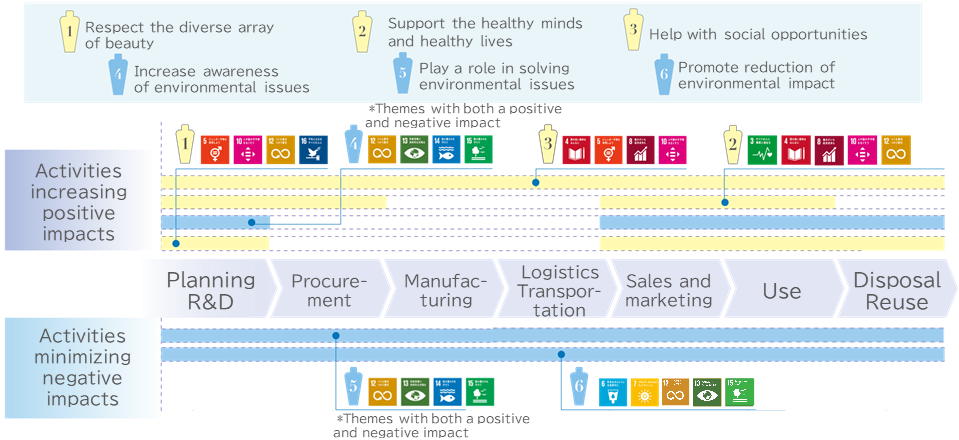
Activity Themes and Their Impact on the Value Chain
The material issues to be addressed in the Sustainability Strategy relate to the entire product life cycle and value chain, from planning, research and development, procurement of raw materials to disposal, and we have identified the value chains that we believe will have a particularly significant impact.
Sustainability Strategy
TOP
Issues and risks surrounding
the business environment, analysis of opportunities, and material issues (materiality)
Medium- to Long-term
Targets
Stakeholder
Engagement